Pharmacy Receipts
Documentation, Text, Reflections...

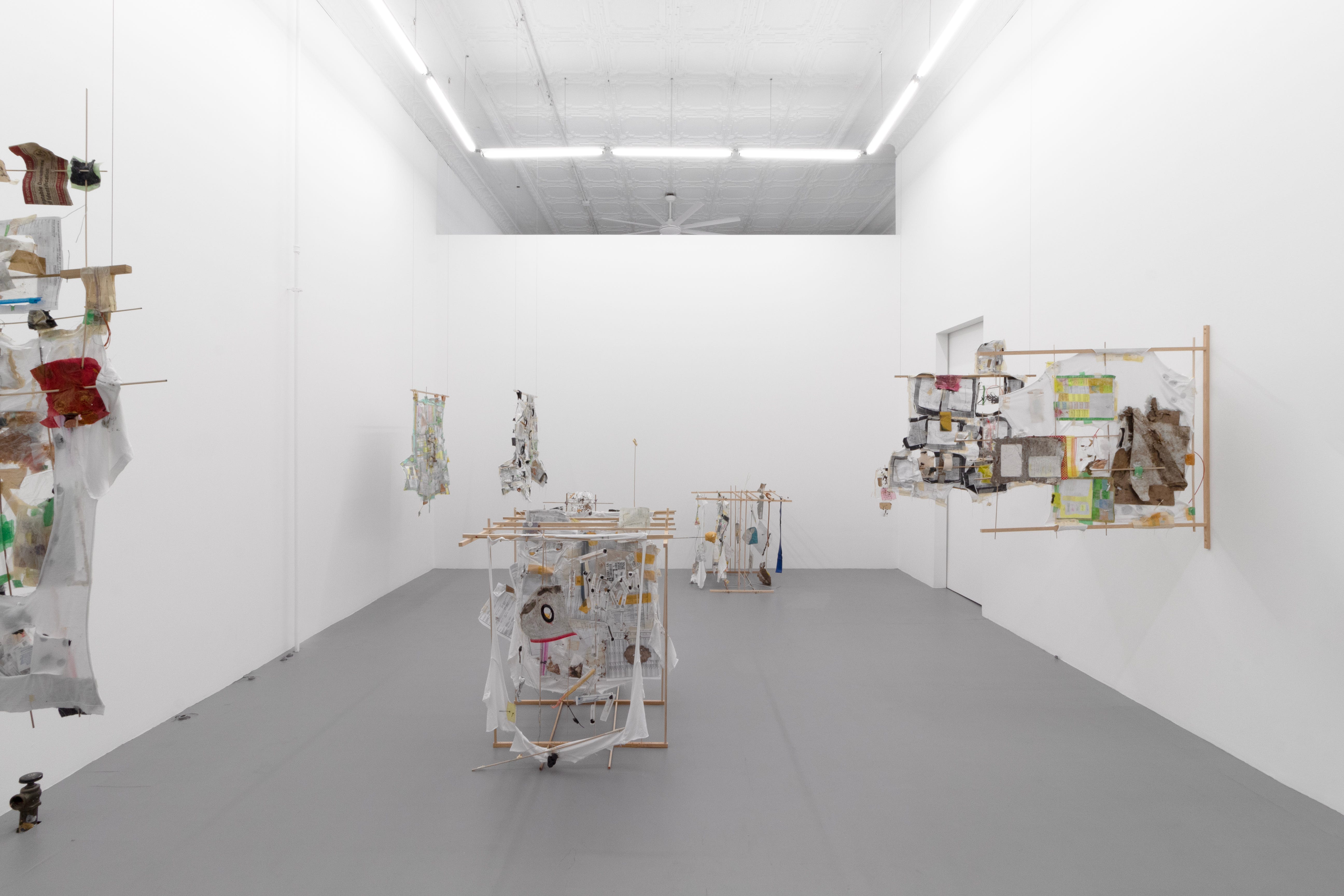
My show of new work, Pharmacy Receipts, came to a close a few weeks back. Thank you to everyone who took the time to come in person during its run, or to look through the documentation. And deep thanks to Jack and Tim, who run Prairie. This show has meant a lot to me <3 Here are some reflections on this body of work.
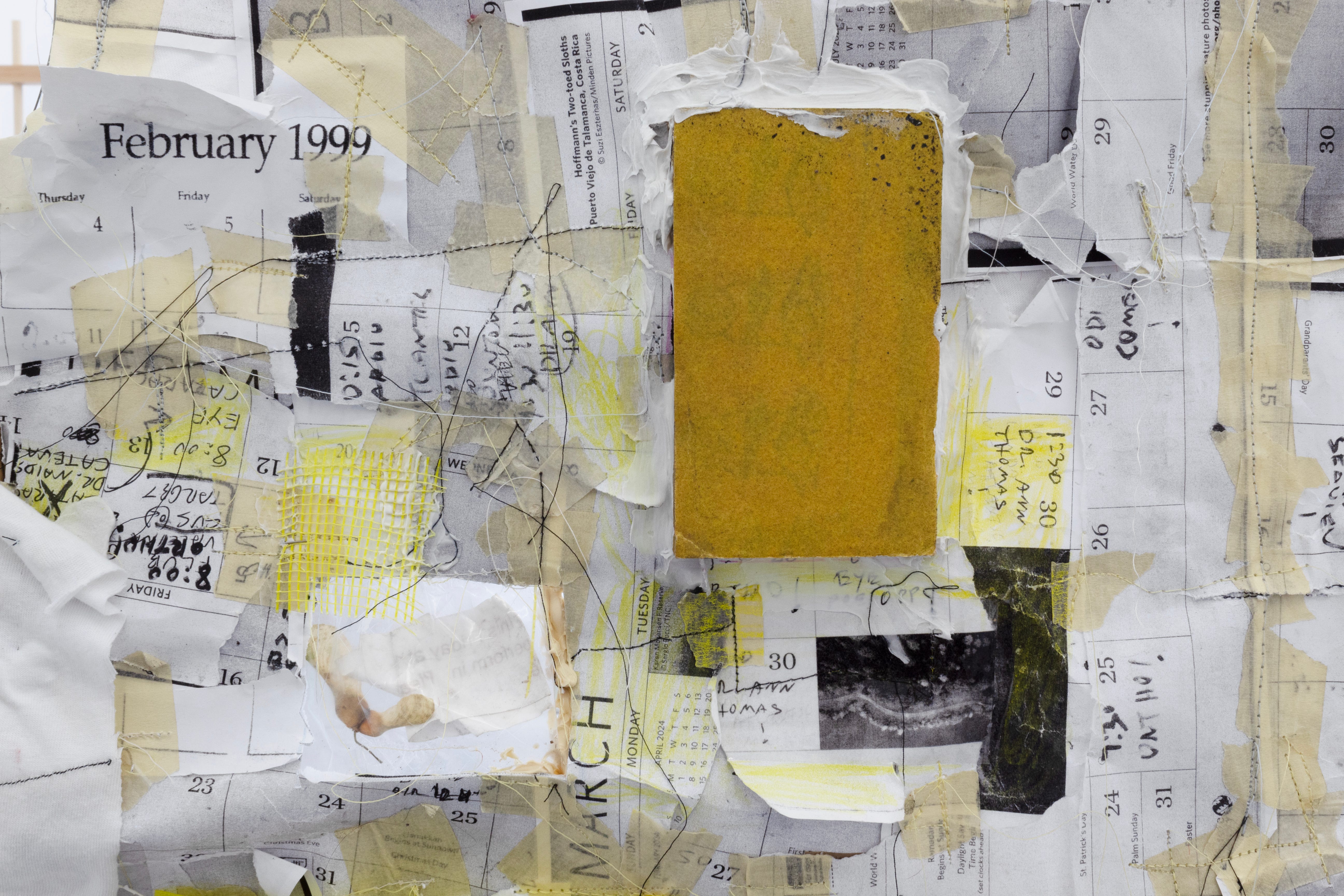
I wrote the show’s accompanying, titular text earlier this spring, and in many ways the writing gave me clarity of purpose in the studio, as the work continued to evolve iteratively. The text privileges the anecdotal over any overt explanation of the formal. In a nod to Chicago’s queer art lineage, I mined my memory of finding Roger Brown’s pharmacy receipts in 2009 to contextualize how I’m approaching found objects in the present. I was excited that people might come to the show already thinking about “pharmacy-receipt-ridden-sketchbooks”, and then encounter a sculptural index of deconstructed t-shirts, documents, and detritus. A kind of physical translation of the text’s proposal, that “everything is a receipt, an artifact, a chronicle, an archive.”
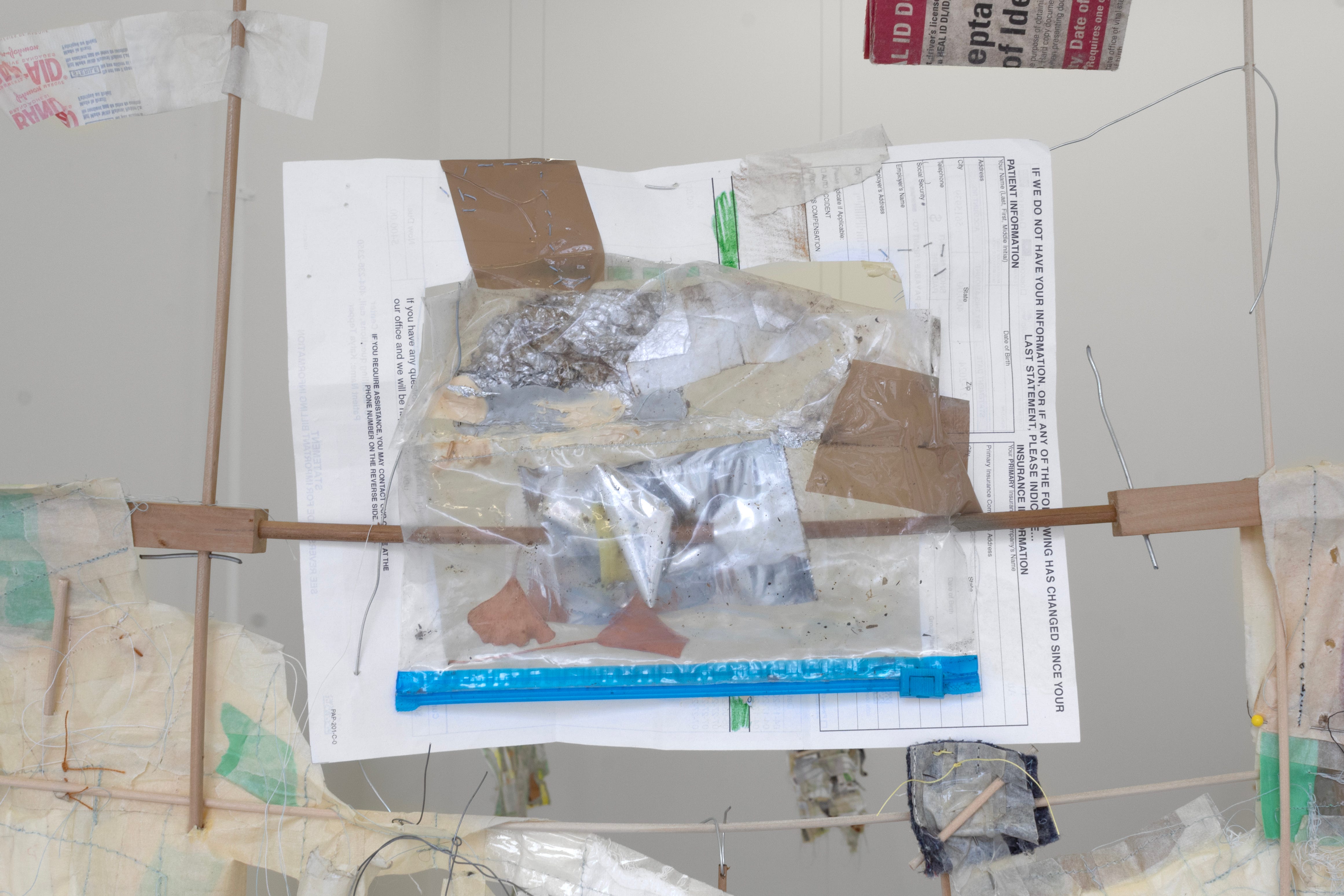
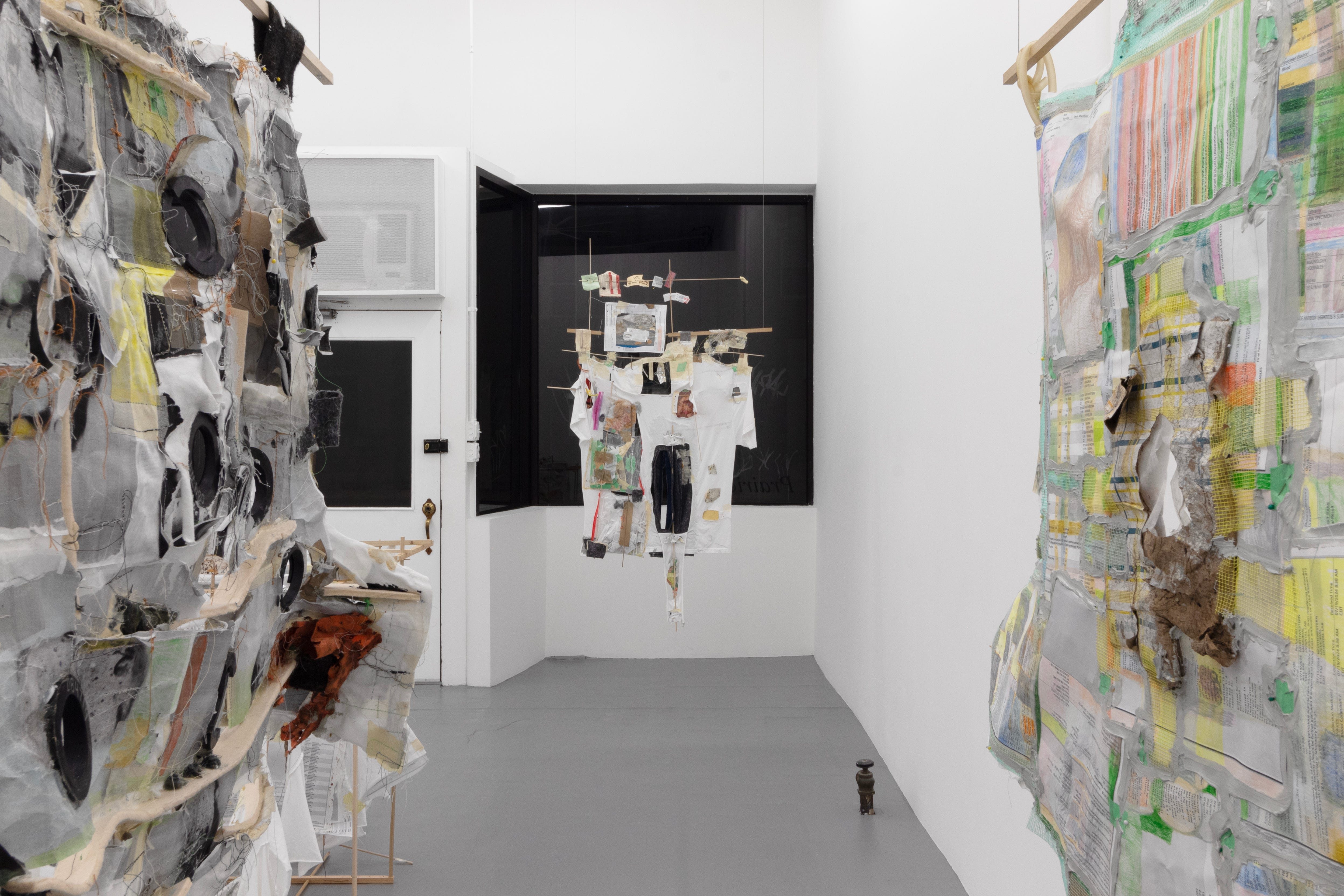
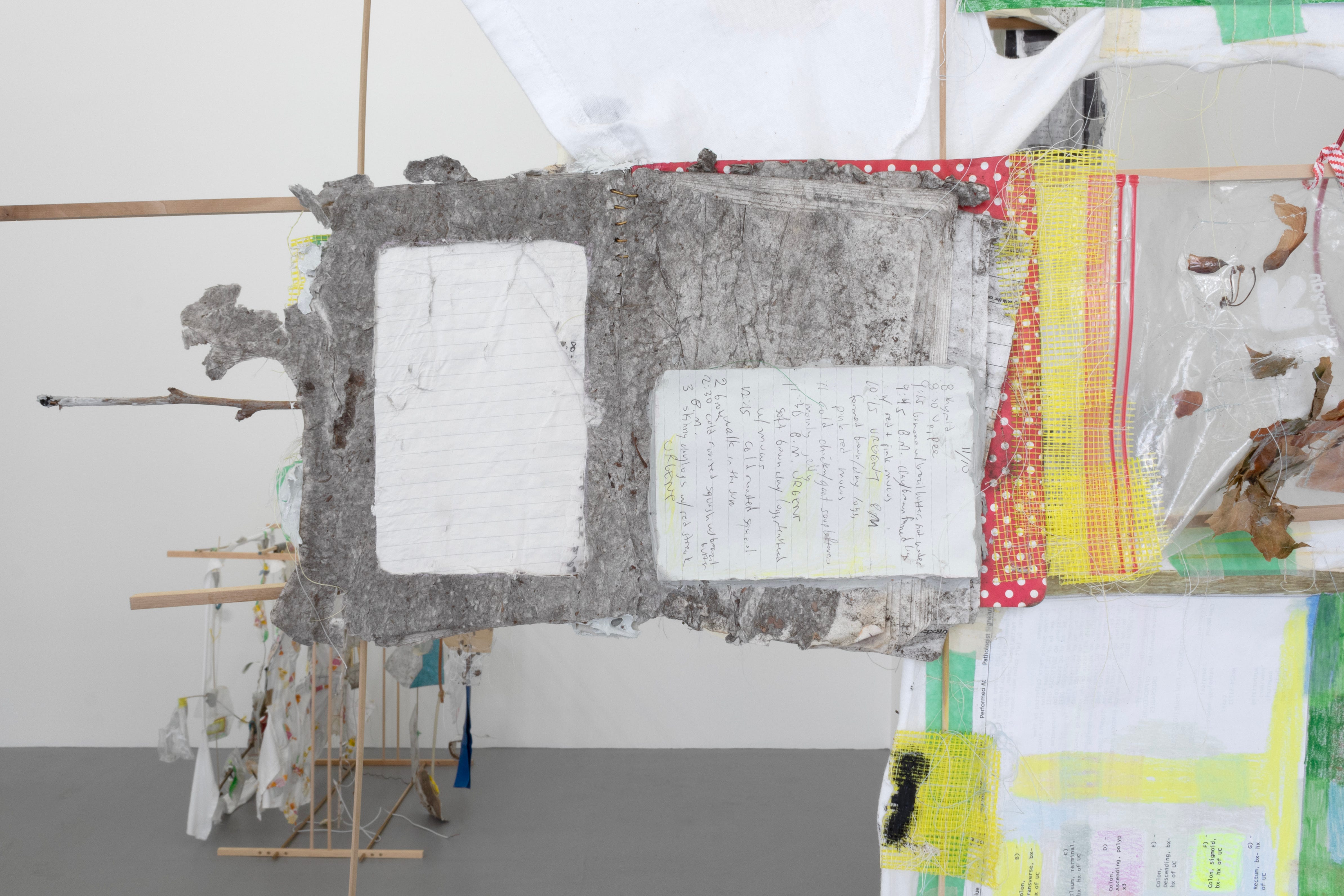
Centrally, the work contends with the challenge of trying to make a t-shirt behave like a document. The works are sculptures in that they are absolutely material and spatial, but they’re also sort of works on paper, or they are papers in space in the same way a filing system is, as mostly flat sheets that can stack and layer over each other, obscuring any discrete view (they’re also full of holes and windows). The white 8.5” x 11” sheet of printer paper and the white t-shirt became a material, formal, and conceptual conceit for approaching seriality, within which each piece still has particular motifs and demands.
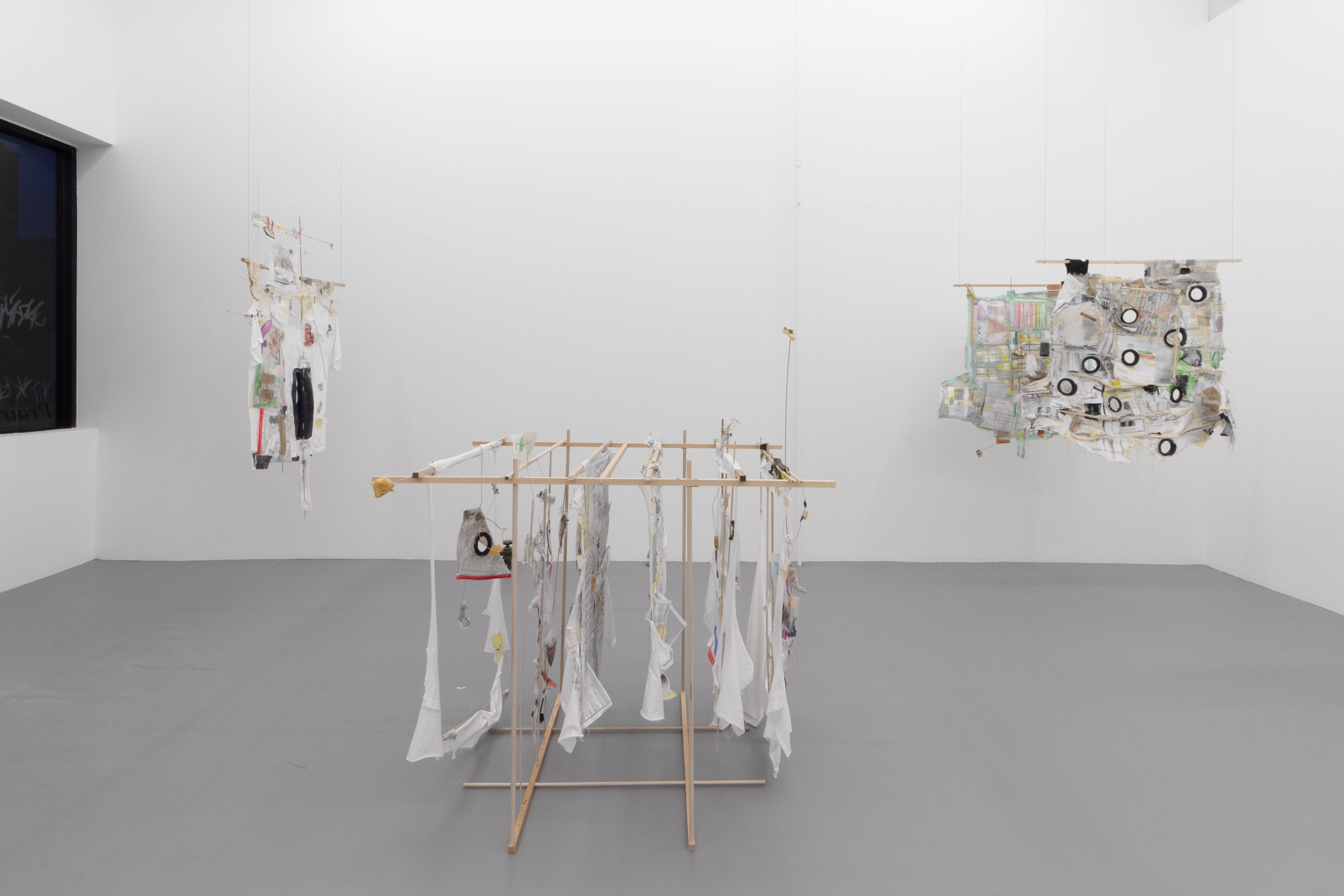
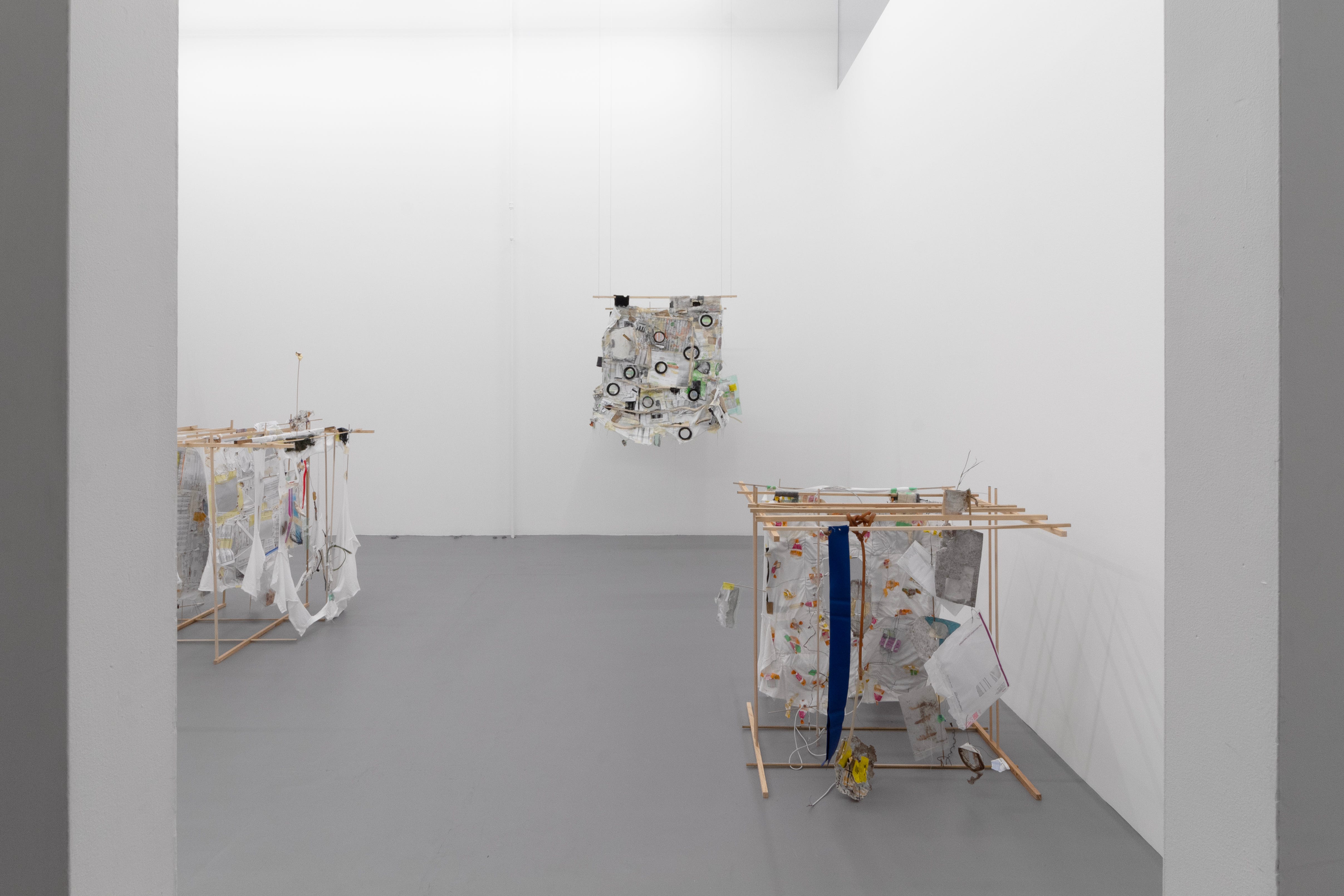
I learned a lot about the work moving from rehearsal installations in my studio to the collaborative process of installing with Jack and Tim at the gallery. Our install prioritized a language of multiplicity while working to establish an order that maintained breathing room for different notes to hit. This ultimately meant editing out some beloved pieces for the good of the group and the room. Decisions for placement were necessarily responsive to the architecture, and I realized that the works were already anticipating this: I used 36” dowels as a standard width, the same measurement for accessible doorways and pathways. Not a huge coincidence, as shirts are also designed for bodies to pass through. In the resulting arrangement, it was impossible to photograph most of these pieces as individual works. Foreshadowed by my text, “I care more about the pharmacy-receipt-ridden-sketchbooks than I do the autonomous painting.”
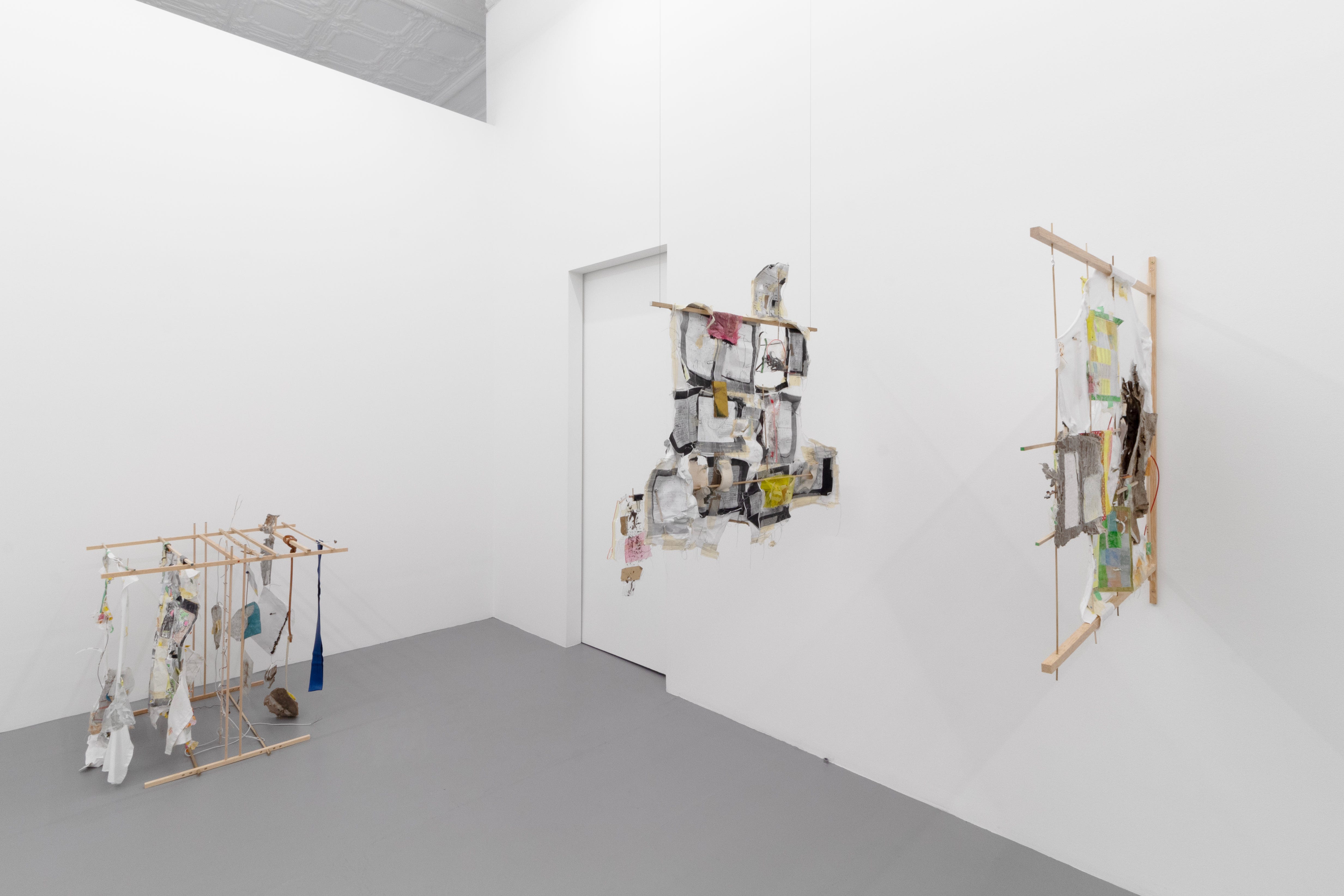
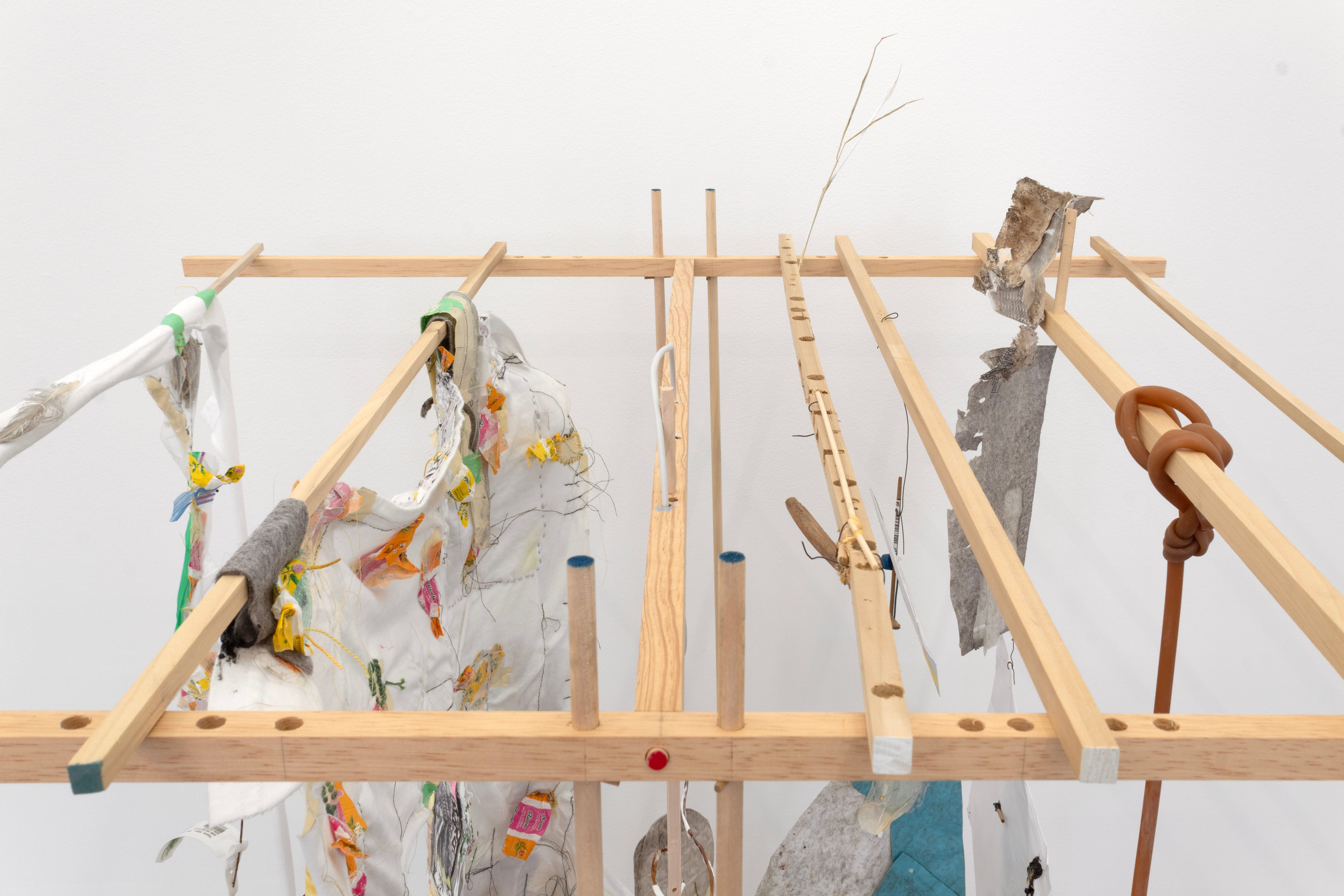
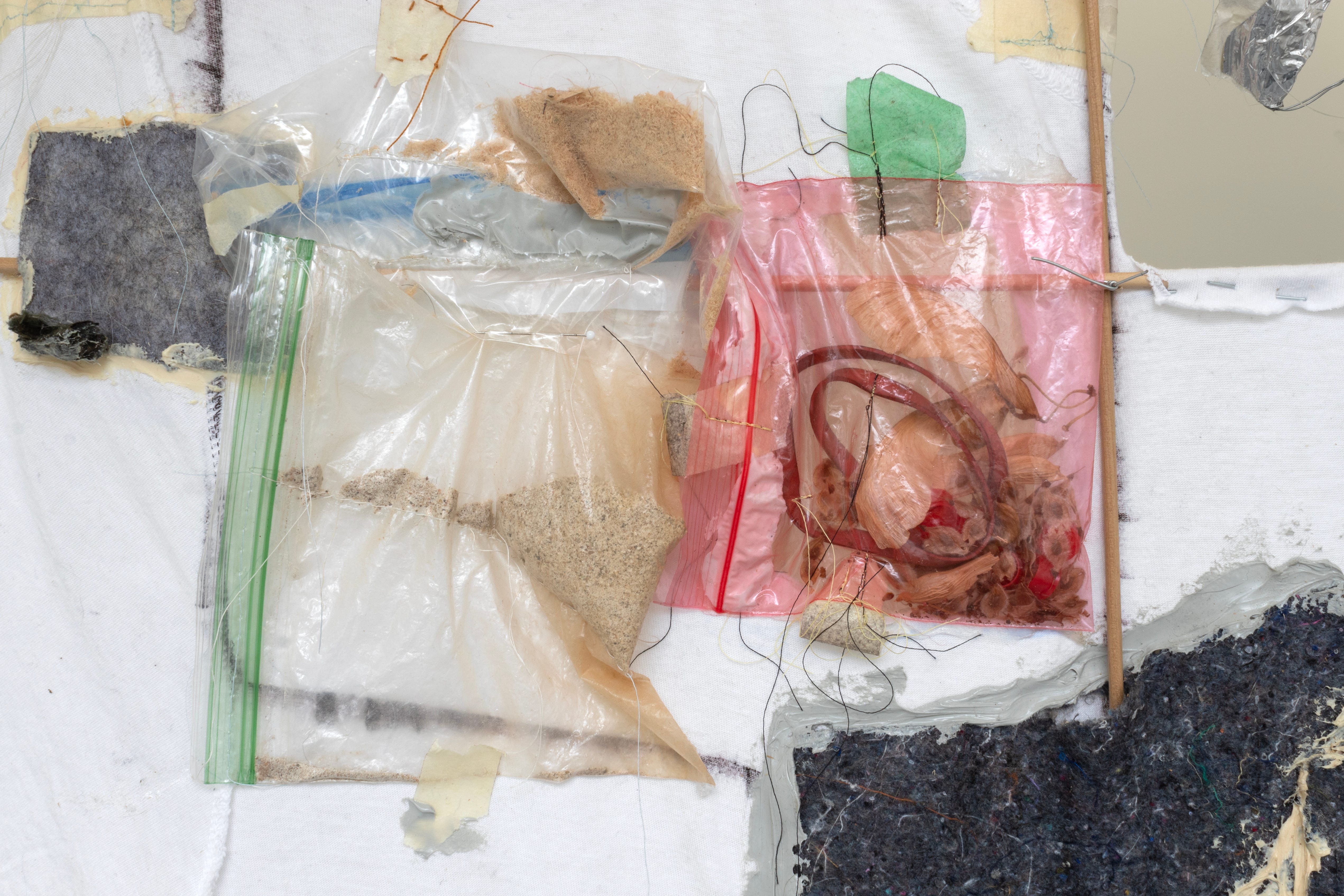
Of the three hanging methods —ceiling, wall, and floor— the floor-bound sculptures represent a huge turning point in my practice. Though I used to perform stand-up, I truly doubted my ability to make anything stand up. Seriously! Any sculptures that I managed to get off the wall were basically completely horizontal on the floor. This made sense to the extent that I side with lying down, and I worship the ground. But since many of the materials I gathered for this work were scavenged from the ground, re-orienting them directionally was important. I’m excited to have developed a construction language for making more dimensional floor-bound structures that still maintain some tension around their own standing. In Make-Shift Archive 1 (MyChart & Easy-Touch) and Make-Shift Archive 2 (Ricola wrappers), there’s a fragility, an implied precarity, to how these pieces hold themselves in space. As entirely modular through-dowel and pin-dowel designs, with no glue and no hardware, there’s an implicit suggestion that everything about them is temporarily configured. They have extra holes, and can be taken apart and re-arranged. And they are flimsy! Parts of them are slightly bowed or leaning. The objects that rest on them and are interwoven through them form a delicate balancing act. The way these objects distribute their weight in relation to each other is integral to the whole thing not collapsing, determining the compositions. They’re almost scales in that sense, with weights ranging from as light as a blade of grass, cigarette filter, cicada shell, and cough drop wrapper, to a bundle of sawdust, to the heavier end — rubber tubing, silicon caulking, a mailing envelope filled with paperwork from Takeda Pharmaceuticals.
There’s more to say about why shirts, why all the different stuff included. But I’d rather take a moment to mention how, in 2019, I tried to make a body of work out of pants. It was my first summer in low-res grad school at Bard. I showed up determined to scale down from the road-sign inspired wall constructions I’d been making, and I immediately started creating paper cut outs in the shape of pants. At first I thought these should function like graphic emblems, as flags for pissing, shitting, and bleeding your pants. Then they became material poems. I dipped them in rubber, cut them out of felt, embedded them with dried carrots, placed yogurt cups full of dirt on their legs, plugged fluorescent lights below them, affixed plungers and insulation-foamed-eggshells to their crotches… haha.
By the end of the summer, I’d cut up the pants into piles of fragments. Then I went home and had a flare-up. And then COVID came. I started writing weird poems about not making sculptures. In a studio visit with a successful, resourced filmmaker, I got lambasted, “why are you making work about not making work?!” ahaha (Anne Boyer’s What is “Not Writing”? was a big influence & surely informed Pharmacy Receipts’ declaration that “the context is the stuff”). By the next summer of my MFA, fully remote, I’d completely dematerialized my practice. I made a video. And then I started to medically transition, and this, to me, became my sculpture practice for a while. It’s been, if nothing else, filled with intense experiences that I can only understand as inherently formal and material. Same goes for being sick, always. By the time I got to Chicago last summer and got a studio, it had been basically 5 years since I had a studio practice. I knew I needed to return to something tactile, to process in registers that video and writing can’t.


It’s funny being an interdisciplinary artist. Somehow I always feel like I’m letting someone down if I can’t maintain consistency. Which is interesting, because my lived experience feels so defined by instability and rupture. Moving between forms and methods, and taking long chunks of time in between, has been a natural way to account for that. Anyway, it’s nice for me to see the kinds of loops and returns of that nonlinear movement starting to reveal themselves more, when I look at this show documentation next to install shots from my video Roasted Cockroach for Scale and see the resemblances. And remembering those pants experiments, too.


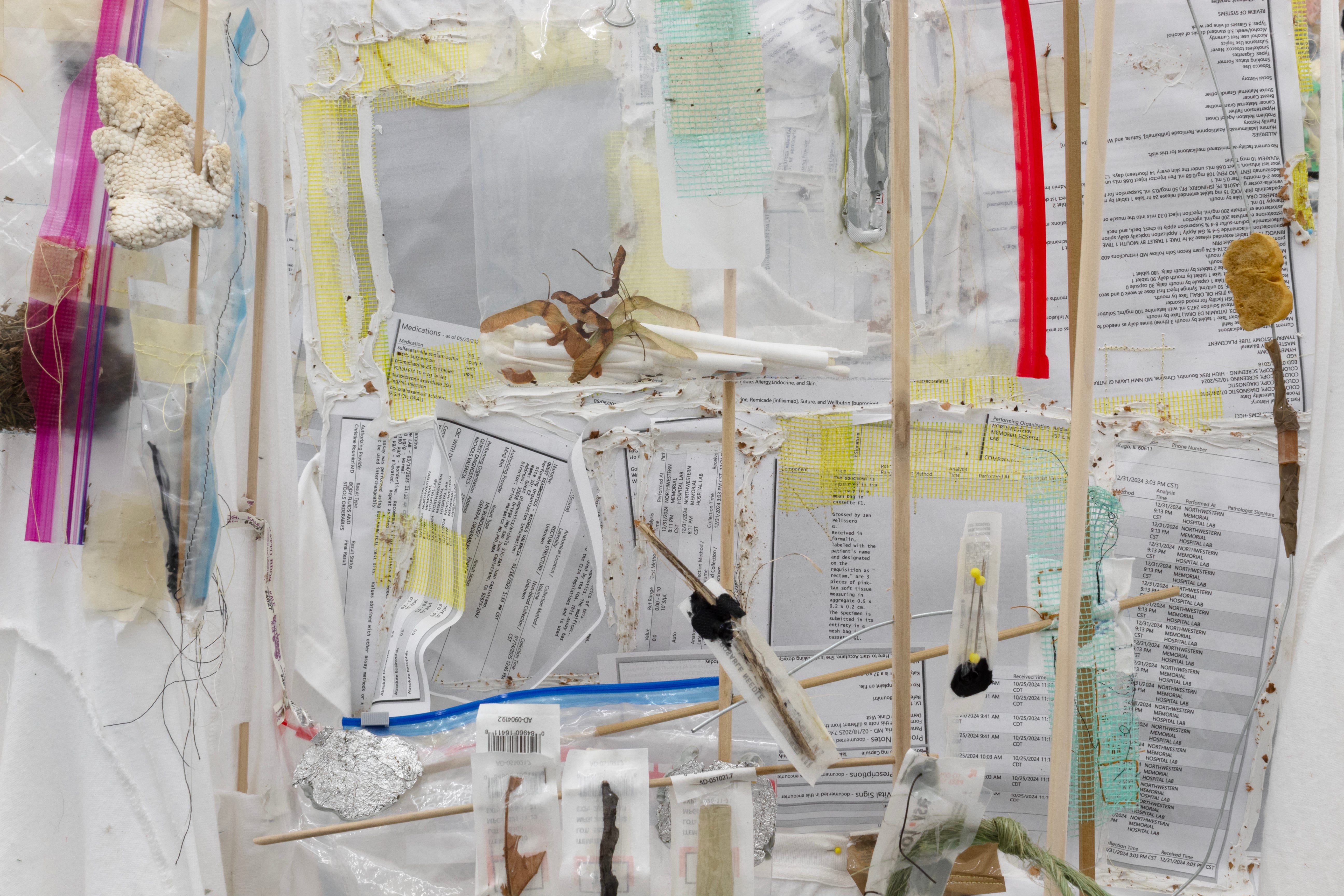
Closing out with some detail shots that didn’t get published on the exhibition’s website. Thanks for reading!!!!!!
Consider supporting Prairie’s programming by purchasing an artwork from their Benefit Auction! https://prairie.indy.auction/auctions/68b62497adc05d780abe42cc